MAHABALIPURAM / MAMALLAPURAM
Mamallapuram is located about 60 Kms.South of Chennai (Madras) on the shores of the Bay of Bengal, along the Indian eastern coast. Known for its rock carvings and monolithic sculptures it has the famous Shore Temple, the only one to have survived the ravages of nature. Also known as the Seven Pagodas (temples), six now lie submerged in the sea. Mamallapuram temples whose architecture was inspired by the Pallava art were built during the period 650 - 1100 AD. It is believed to have been named after the famous Pallava King Narasimha Verma Pallava, the first, who was also known as MAMALLA, or the great wrestler. According to some historians these were built to celebrate Narasimhavarman's victory in AD. 642 over the Chalukyan king Pulakesin II.
Mamallapuram was a sea-port during the time of Periplus (1st century AD) and Ptolemy (AD 140) and many Indian colonists sailed to South-East Asia through this port town.
Mamallapuram has been classified as an UNESCO World Heritage Site.
Mamallapuram has the following sculptures:
STHALASAYANA PERUMAL TEMPLE
This temple is of Pallava period except that the original temple was expanded in Vijayanagar times. In this temple, Vishnu is seen lying on ground instead of on Adisesha, that is how the name comes.
THE SHORE TEMPLE
A temple built along the Bay of Bengal with the entrance from the western side, away from the sea. The temple was reconstructed stone by stone from the sea after being washed away in a cyclone. There are 3 shrines in the Shore Temple. Two of them are Saiva and the third is Vaishnava, with an image of Lord Anantasayi made of a single rock. There are Vimanas over the Saiva shrines, but none over the third, it seems to have disappeared with time.
Recent excavations to the north and south of the Shore Temple have revealed rock-cut figures representing religious themes of period prior to the construction to the temple. Besides, a monolithic Bhuvaraha, a reclining image of Vishnu, a base of Durga shrine with deer and a square socket possibly to accommodate Mahastambha have also been exposed. A stepped ghat facing the sea to the south of the Shore Temple was also exposed recently.
THE ARJUNA'S PENANCE
This is one of the most famous stone carvings at Mamallapuram. It is an enormous relief made on two massive boulders. One of the biggest open-air rock canvases in the world, the Arjuna's penance is 31m long and 9m high. The surface of the rock has detailed carvings, showing the most endearing and natural renditions of animals especially the elephants and monkeys. Arjuna's Penance has over 100 figures of gods and semi divine creatures, birds and beasts, man and saint and is one of the most beautifully carved structures at Mamallapuram. The figures that are sculptured on the rock are remarkable for their vitality and spontaneity and speak volumes about the skill of the sculptors.
There is another explanation to this bass-relief.
Legend has it that King Bhagiratha had to bring down to earth the celestial Ganga to sanctify and redeem the cursed souls of his ancestors. But the river in its torrential spree would deluge the earth, and so he had to undergo a penance to propitiate Shiva who finally received the flood in his matted locks and let it flow down. This was a sight for the world's creatures to see and they gathered round. The cleft in the rock depicts the descent of Ganga, a theory supported by the ruins of a stone water tank on the hill. There is a forest with tribal people and all forms of fauna, just as they would appear in their habitat. Women clothed in an aura of amazing grace, a rich inner beauty transfiguring the plainest of them.
THE FIVE RATHAS
The five Rathas include The Yudhishtra, Bhima, Arjuna, Nakula/Sahadeva and Draupadi. The five Rathas, about 200 m south of the main hill, were fashioned out of a smaller hill sloping down from the south. From the largest part was made the biggest of the five rathas, the Yudhishtra. Then followed onwards north, in the descending order of height, Bhima, Arjuna and the Draupadi.
A little to the west of Draupadi there was a comparatively large rock and out of it the Nakula/Sahadeva Ratha was made. Immediately in front of the Draupadi again two smaller rocks were sculptured into an elephant and a lion. Behind the Draupadi and the Arjuna, which stand on a common base, there is a Nandi.
These five Rathas were all carved out of a single piece of granite in situ.
OTHER IMPORTANT STRUCTURES are the Mahishamardhani, the Adivaraha and Govardhanadhari temples
IN CONCLUSION
As mentioned at the start of this article, Mamallapuram lies approximately 60 Kms, South of Chennai. There are two excellent roads from Chennai,the East Coast Road and the Old Mahabalipuram Road. The distance can easily covered by car in about 75 minutes.
I found that generally visitors leave Chennai after breakfast, say around
9 am and reach by 10.15am. They spend the day visiting all the places and leave Mamallapuram by 5.30 pm to return to Chennai by dusk. I thought this is a little tedious as the place is very hot during the day due to rock formations.
So we decided to reach by 3pm by a private car. We had sufficient time to have darshan of Sthala Sayana Perumal.We then went around visiting Arjuna Penance, Krishna Butter ball, Govardhanagiri and Adivaraha temples. Then we spent some time on the excellent beach.
We stayed over night at Indeco Boutique Resort (also known as Sterlng Resort) which is right near the sea shore. A paved path of about 100 M connects to the beach. This resort has all cottage type accommdation and looks like a heritage structure.
There are quite a few good resorts and hotels in Mamallapuram for all budgets.
The next morning we left the resort at 6.30 am and visited the Shore Temple. We had really a leisurely look as we were the only visitors at that hour. After that we again spent some time on the beach. We then returned to the resort for breakfast and left immdiately for another round. This time we visited the Pandava Rathas and Mahishasuramardhini cave. We had another darshan of Perumal also.
All this could be done comfortably in the cool climes of evening and early morning and one could also enjoy the beach.
Another interesting factor is that there are a large number of sculptors in the place. All along the road you can see wonderful sculptures of all sizes and shapes from mytholgy, history and some of even Venus.
We found that the State Road Transport Corporation is running ordinary and airconditioned express buses to Chennai(Adyar,T.Nagar and Koyambedu) at frequent intervals. We took the airconditioned bus which left at 11.30 am. The journey was very comfortable. Surprisingly the charge was only Rs.55. per head.The bus took only 40 minutes to reach ADYAR, from where we took an auto riksha to go home.
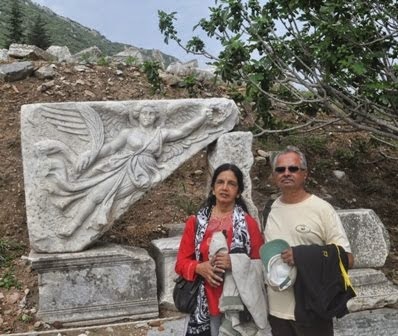
In the photos serial no. 1 to 24 are ancient sculptures while the rest are of modern origin.
14and 15th July, 2009
Thursday, July 30, 2009

Sunday, June 14, 2009
ROCK CLIMBING AND RAPPELLING AT MUMBRA. 07TH JUNE, 2009
ROCK CLIMBING
It is not quite easy to define rock climbing, but it is not difficult too. Anyone who claims to be a rock climber has his own version of the game. Rock climbing for some is to challenge their spirits and explore new heights, to give a fillip to their unbounded imaginations; for others, it is a way telling the world that he/she has finally arrived. For many of the professional rock climbers, it is not a sport. Can you call a mission to moon a sport or pastime? If not, then why should rock climbing be called a sports is the argument. For them, rock climbing is an adventure of the greatest magnitude; it is a fight against self, against the elements, and the ultimate goal is to reach the summit and return back alive.
Rock climbing is a test of strength, concentration and coordination as well as skill and technique. A climber learns from experience that the mountain must not be taken for granted.
It can be rough and antagonistic to those who venture to come to grips with it. Nevertheless, as a sport, climbing continues to offer a thrill and challenge that is compulsive.
In India, rock climbing, as most other adventure sports, is a relatively new sport. However, in a short span of time, it has become the most popular adventure sport. Because of the good distribution of great climbing rocks throughout India, coupled with the element of excitement involved, rock climbing has become the sport to participate in for the young and the old alike.
Courtesy Temple Pilots)
Today I went for a rock climbing and rappelling expedition. We were a group of 8 people led by the organisors, who were 5.
We left Dadar, Mumbai, about 7 am and reached Mumbra about 8am. From there it took us another hour to reach the foot of the rock. Mumbra, just after Thane has a temple well known to everyone in Maharashtra. The temple is situated atop a hill around
100 M high with a steep set of steps.
About half way through, one has to walk into a jungle on the right side which leads to a number of rock formations. This is where rock climbing is done. The rock we tried was about 25 M high.
The instructor explained how climbing and rappelling has to be done.After the harness and helmet are put on,the rope hanging from top of the rock is clamped to the harness near the waist. The person on top of the hill who controls the slack of the rope has to be warned that climbing is going to start.Out of the four limbs,three should always be holding on to the rock. One has to find a proper foot hold or grip for the hands. Then weight of the body should be shifted to that limb and with the help of the other three limbs the body has to be pulled upwards.While doing this further holds should be checked.After a little climbing the rope will slacken and the controller has to be told to tighten it. This is done to prevent deep fall in case one slips.The climb was rather difficult as not many holds were available for your limbs. Some how, some of us managed the climb.
RAPPELLING
Rappelling is a form of controlled descent from the top of the hill, using a rope anchored at the top. It relies on the friction between the rope and your body, or through a mechanical device (billet).Generally the rope is passed through a friction device in your harness. One hand is used to guide your descent while the other hand regulates the pace of your descent. Your body should be in an ‘L’ shape, with legs straight, feet apart planted firmly on the rock surface. Your body weight takes you down while the friction device controls the pace of the descent. You have to slowly walk backwards down the rock face, while releasing the rope with the rear grip.
After the difficult climb,rappelling was not very difficult, everyone did it with ease.
It was extremely hot and humid and every one was tired by 11am, by which time all participants had tried and some completed the climb.
Saturday, May 30, 2009
PARAGLIDING , 14TH MAY , 2009.
PARAGLIDING , 14TH MAY , 2009.
You want to fly? Why do you want to fly hundreds of meters above the ground, over looking hills, fields and rivers? It is a challenge, a dream, an intimacy with nature and the beauty of the open blue sky, the clouds, the birds and the wind blowing into your face, which is difficult to explain.
This is why some take to Para gliding.
My son Ravindra is a trained para glider. For quite some time, I have been asking him to take me for the gliding. At last we made it on Thursday the 14th May, 2009. We traveled to a place called Karla about 100 kms. from our place on the Mumbai- Pune road (just beyond Lonavala, a hill station). The para gliding club has an office cum residential accommodation there. We had lunch and waited for some time as the day was very windy for gliding. Around 3pm we left from there and traveled about 15 kms on a gravel road to reach the foothills. Since the road is bad, we traveled in a SUV. There is a plain ground at that point which is used for landing as well as for training recruits in ground handling of the glider. We climbed up from there to a hill top about 100 M high, which is reasonably plain for take off. We used local boys for carrying the equipment up and down the hill. First I wanted to try. A harness was put on me and I was clamped to the instructor who was behind me. The instructor first makes the glider float and suddenly turns and we start running for a small distance and then we take off. We went to about 350m height and flew for about half an hour. He did a few acrobatics after confirming that I am not scared or suffer from vertigo or other problems. It was a little scary, but was thrilling. We tried to land at the same point from where we took off, but because of high velocity winds and shortage of space there, we could not land. After some more flying we landed in the plain below. Over all it was a great experience. Then my grand daughter Rhea, all of 6 years age, wanted to try. The harness was put on her. Ravi checked with her whether she is comfortable. She seemed to be amused by the whole thing and said she is fine. Then they took off. We could see that she was really enjoying the flight. She was waving her hands to us from that height. We saw that the instructor was doing acrobatics. I was a little bit worried. After about half an hour flight they landed in the plain where we were waiting. We could see the thrill on her face. The instructor told us that she asked him to do the acrobatics. When he started coming down to land, it seems she told the instructor that she felt that the flight should never end. She also told him that she will come back and learn to fly solo soon. These flights normally last for 10 minutes, but because of Ravi's association with the school, both my self and Rhea flew for more than half an hour each. The training school is run by two instructors. One of the instructors competes at national level competitions.
Subscribe to:
Posts (Atom)