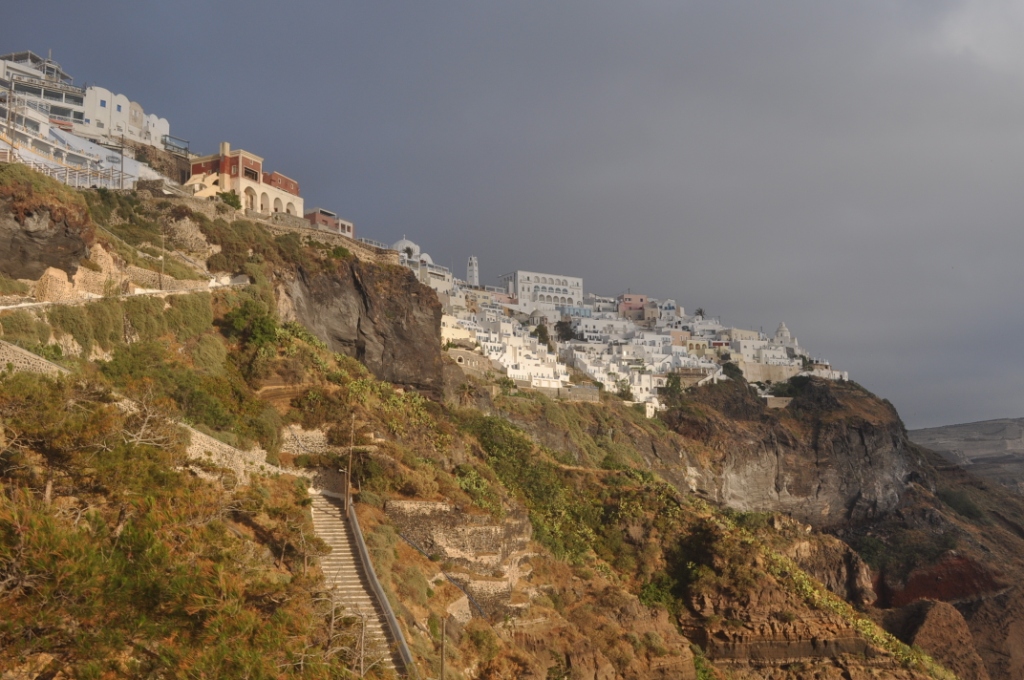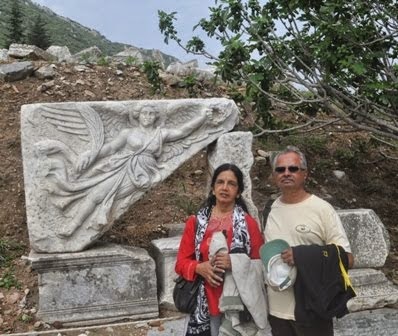
On the morning of 12th May, the ship anchored in the sea near Crete. We were told that it will be difficult to see Crete on our own and hence we joined the trip arranged by the ship. This costs 49 Euros per head. We had an early breakfast and left the ship at 7 am.
CRETE is the largest and most populous of the Greek islands and the fifth largest
island in the Mediterranean Sea.
Crete
is one of the most popular holiday destinations in Greece. Fifteen percent of
all arrivals in Greece come through the city of Heraklion (capital, port, and airport), while charter journeys to Heraklion last year made up 20% of all charter flights
in Greece. Overall, more than two million tourists visited Crete last year.
Ancient Palace of Knossos
Mythology has it that it was in a cave of Crete where
the goddess Rhea hid the newborn Zeus. In that cave, Zeus was brought up
by the nymphs while the demonical Kouretes would strike their shields loudly so
that Cronus may not hear the crying of the baby Zeus and eat it. It was
also to Crete that Zeus, disguised as a bull, took Europa so that they may
enjoy their love together. Their union produced a son, Minos, who ruled
Crete and turned it into a mighty island empire of the seas.
The
legend of the labyrinth dates back as far as 2000 BC according to the historical evidence
being built on top of a Neolithic settlement populated in 6.000BC. The Palace itself was excavated and
reconstructed in 1900.
The
Palace of Knossos was undoubtedly the ceremonial and political centre of the Minoan civilization and culture. It appears as a multistoried
structure with many floors, innumerable corridors and colonnades, a maze of
workrooms, living spaces, and storerooms.
It
encompasses an area of 22.000m2, with a population reaching 80.000 people
evidenced by the presence of cemeteries nearby.
The water management system of the
palace was amazing.
The palace
had three separate water-management systems: one for supply, one for drainage
of wastewater and one for drainage of runoff.
Aqueducts brought fresh water from springs on hills located about 10 km
away. Aqueducts branched to the Palace and to the town. Water was distributed
at the Palace by gravity feed through terracotta pipes to fountains and spigots. The
pipes were tapered at one end to make a pressure fit, with rope for sealing. No
hidden springs have been discovered at Mycenae.
There were
series of public toilets in the palace. Sanitation drainage was through a
closed system leading to a sewer apart from the hill. The Queen's
toilet contained an example of the first water-flushing system toilet adjoining the bathroom. This toilet
was a seat over a drain that was flushed by pouring water from a jug.
The bathtub located in the adjoining bathroom
similarly had to be filled by someone heating, carrying, and pouring water and
was drained by overturning into a floor drain.
This toilet and bathtub were exceptional structures within the 1,300-room
complex.
As the
hill was periodically drenched by torrential rains, a runoff system was a
necessity. It began with channels in the flat surfaces, which were zigzag and
contained catchment basins to control the water velocity. Probably the upper
system was open. Manholes provided access to parts that were covered.
Apart from the Minoan palace complex, today’s visitor can enjoy the richly decorated internally with mural paintings, public buildings and religious centres A luxury private villa still survives today, colonnaded externally with magnificent mosaic floor tiles dating from the Roman era.
The numerous artifacts of exquisite art have been dug out from the palace, like various pots, vessels, utensils, idols, tablets, and original murals
The throne room is the most interesting area of the complex. The throne is flanked
by the Griffin Fresco, with two griffins crouching facing the throne, one on either
side. Griffins were important mythological creatures, also appearing on seal rings.
The
entire visit to Crete including the Knossos Palace took about 3 hours and we
returned to the cruise ship by 11 am.

 |
| Storage pots |
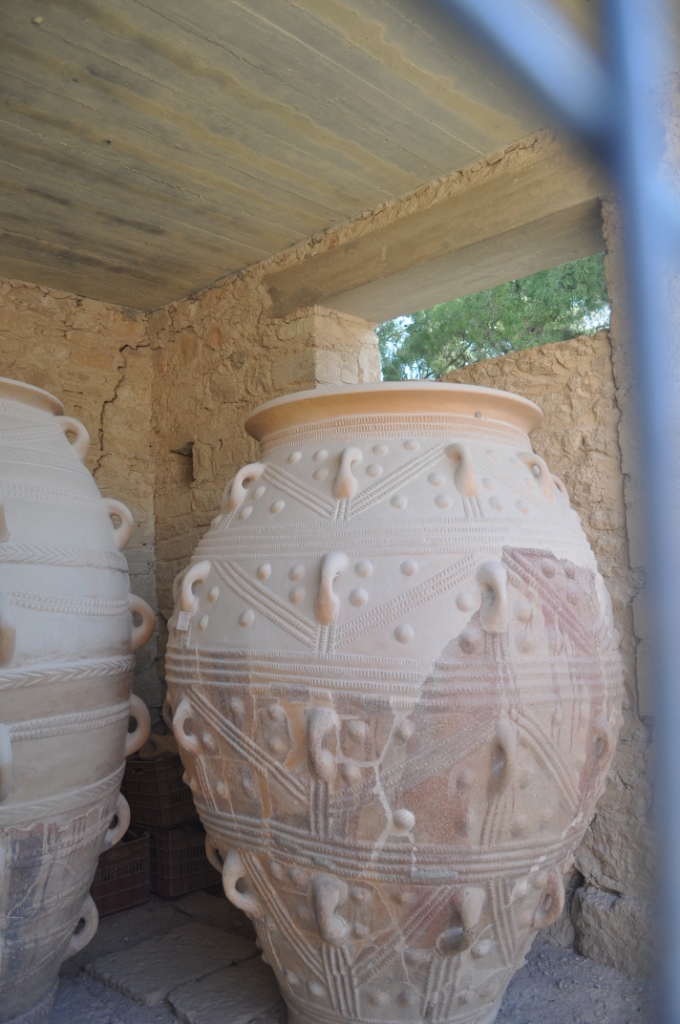
 |
| The Throne room |
 |
| Ceremonial vessel in the throne room |
 |
| Griffin |

 |
| Bull Jumping |
 |
| The Palace |
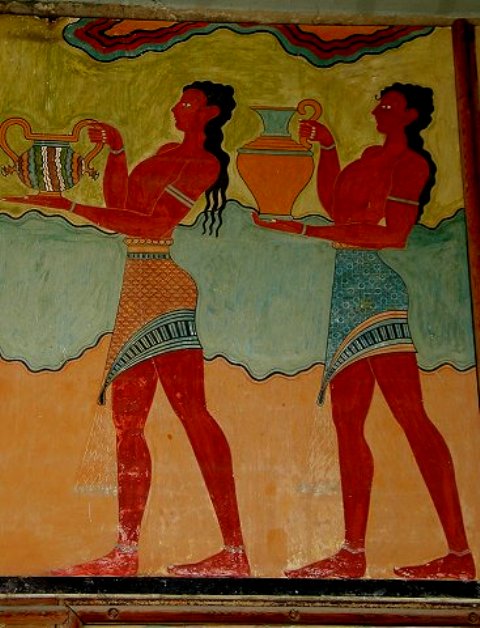 |
| The cup holders |

 |
| Drainage system |

 |
| Prince of Lillies |


 |
| Dolphin Fresco |


The cruise ship then sailed towards
Santorini, one of the most fascinating of Greek islands.
We left the ship at 5 pm and took the
guided tour of Santorini. The total cost of visiting both
Crete and Santorini is 198 Euros.
There are no archeological sites on
Santorini except in Akrotiri, which is the best known Minoan site after Crete. Unfortunately
we could not visit the site due to shortage of time.
Santorini looks more or less like our
own Mussoori or Shimla with narrow roads, cobbled pathways and steep slopes. Curio
shops and cafes line the roads and lanes.
General mode of transport is the QUAD,
a
four wheel all terrain vehicle, which is driven at high speed all over the
island.
SANTORINI.
An
alternative name for Santorini is Thira. Santorini is also a name for the
family of islands surrounding Thira, once forming a single island prior to a
major volcanic event in approximately 1628 B.C.E A giant central, rectangular
lagoon, which measures about 12 by 7 km is surrounded by 300 m high steep
cliffs on three sides. The main island slopes downward to the Aegean Sea. On
the fourth side, the lagoon is separated from the sea by another much smaller
island called Therasia;
the lagoon is connected to the sea in two places, in the northwest and
southwest. The caldera being 400m deep makes it possible for all but the
largest ships to anchor anywhere in the protected bay; There is also a newly
built marina on the southwestern coast. The principal port is called Athinias.
The capital, Fira, clings to the top of the cliff looking down on the
lagoon.
Santorini
has no rivers, and water is scarce. Until the early 1990s locals filled water
cisterns from the rain that fell on roofs and courts, from small springs, and
with imported assistance from other areas of Greece. In recent years a desalination plant has
provided running, yet non-potable, water to most houses. Since rain is rare on
the island from mid-spring till mid-autumn, many plants depend on the scant
moisture provided by the common, early morning fog condensing on the ground as dew. There are no large trees on the island.
The
island remains the home of a small, but flourishing, wine industry,
based on the indigenous grape variety.
Fira is
the fiery capital, a marriage of Venetian architecture, whose white cobblestone
streets bustle with shops, taverns, hotels and cafes, while clinging to the rim
of the caldera nine hundred feet above the its port. If arriving by sea you can
take a cable car up from the port or alternatively take a trip on one of the
hundreds of mules up the 588 zigzagging steps. You could also attempt to walk
up the steps but be warned, they are winding, narrow in parts with only low
walls, they are covered in donkey excrement and the donkeys themselves will
make no attempt to avoid you.
Walking
along a path for about twenty minutes will bring you to the top where you can take
in the magnificent view of the island’s unique scenery from the tiny town.
Due
to the spectacular and unique natural beauty of Santorini, many Greek singers
have chosen the island as the setting of their videos. TV series have been shot
in Santorini, as well as some Hollywood movies (e.g. Tomb Raider II). Generally Santorini is a
pole of attraction for Greek and international celebrities.
Usually, the meals are served in the Main Dining Room (deck 4)with the choice between a table d'hôte (set menu) or a buffet, or in the closed hall “Lido”, on the top deck, for casual meals, as well as in
several areas of the ship (such as next to the pool), where barbecues are set up for pizza baking,
burgers, hot dogs, pasta etc.
We
were told that Michael Jordan’s yacht was anchored in the Marina.
We
returned to the cruise ship around 8 pm.